Small Business Expense Spreadsheet (Free Excel & Google Sheets)
A free small business expense spreadsheet with a built-in profit and loss summary. Copy it, log your income and every vendor and payroll cost, and see each expense land on the right Schedule C line.


A small business expense spreadsheet should do more than list what you spent. It should show what came in, what went out, and the profit left over, with every cost landing on the right line of your tax return. I built one that does all three, and it's free. You copy it, log your income on one tab and your expenses on another, and the first tab builds a profit and loss that shows your real profit and maps each cost to its Schedule C line.
When you hand things to a preparer, our tax organizer with a Schedule C summary lines your totals up with the form.
Run a food truck? The food truck version maps prep-kitchen rent, propane, and booth fees to their Schedule C lines.
That profit and loss is the part that pays you back, and it does three jobs at once. At tax time, the totals drop straight onto the right lines of your Schedule C, so you don't miss a deduction or hand your preparer a guess. All year, it keeps your books current, which is the one thing your bookkeeper wants from you, instead of a year of receipts dumped on the desk in April. And it makes you a sharper owner, because your bank balance can fool you. The cash in your account says nothing about the payroll, the card bill, and the taxes already spoken for. Your profit, what you keep after costs, is the real score you run the business by.
I run Shoeboxed, a receipt-scanning company. We've sorted receipts for small businesses for 20 years, and that gave us a clear look at where the books quietly break. So I pulled the numbers on 109 small businesses that run payroll or pay contractors. I built the spreadsheet around the two things almost none of them track, even though both move the tax bill.
If you're a one-person shop, a freelancer, or you file a 1099 and have no employees, this isn't the sheet for you. I made a simpler one for that: the self-employed income and expense spreadsheet. This page is for a business with vendors, and maybe a few people on payroll. If you reimburse those folks for out-of-pocket costs, grab our expense reimbursement form too.
Paid on 1099s as a contractor? The 1099 expense tracker maps every cost to its Schedule C line for you.
And if you just want to track expenses in Excel without the income or payroll side, the free Excel business expense template does exactly that.
Get the spreadsheet
Copy the spreadsheet to my Google Drive →
Tap it, sign in to Google, and choose Make a copy. The sheet is yours to type in, and nothing you enter touches my version.
Want another format? Download it as Excel (xlsx), or print the PDF and fill it in by hand.
It opens on a profit and loss statement that fills itself in. Here are the six tabs:
- Income Statement. Your profit and loss, and the first thing you see. It builds itself from the other tabs and mirrors your Schedule C: income, minus expenses, minus the home office, equals the net profit you're taxed on.
- Income. One row for each payment you take in.
- Expenses. One row for each cost. The category dropdown carries the Schedule C line it belongs on.
- Home Office Log. Both ways to figure the deduction for the owner who runs the business from home, the simple one and the one that usually pays more.
- Mileage Log. Four fields per trip, and the tab does the per-mile math for you.
- A bonus 25% off code for Shoeboxed, in case you'd like us to do the typing instead.
The home office and the mileage tabs each feed their own line on the profit and loss, so the deductions that don't arrive as a receipt still land on the form. If you only do one thing on this page, copy the spreadsheet. The rest of this article explains the rules behind it, because two of them put real money back in your pocket.
What businesses with staff track, and the two things they miss
I want to show you something we found in our own books, because it explains why most expense spreadsheets leave money on the table.
We took a close look at 109 small businesses on Shoeboxed that tag payroll, wages, or contract labor, 96,353 receipts in all, over the last two years. These are paying Shoeboxed customers, not a national survey, so read it as what we see in our own data.
And these are organized businesses. Only about 1 in 8 receipts came in without a category, which is tidy for a real company with vendors. They track the money going out in detail, and the gap is on the other side of the ledger.
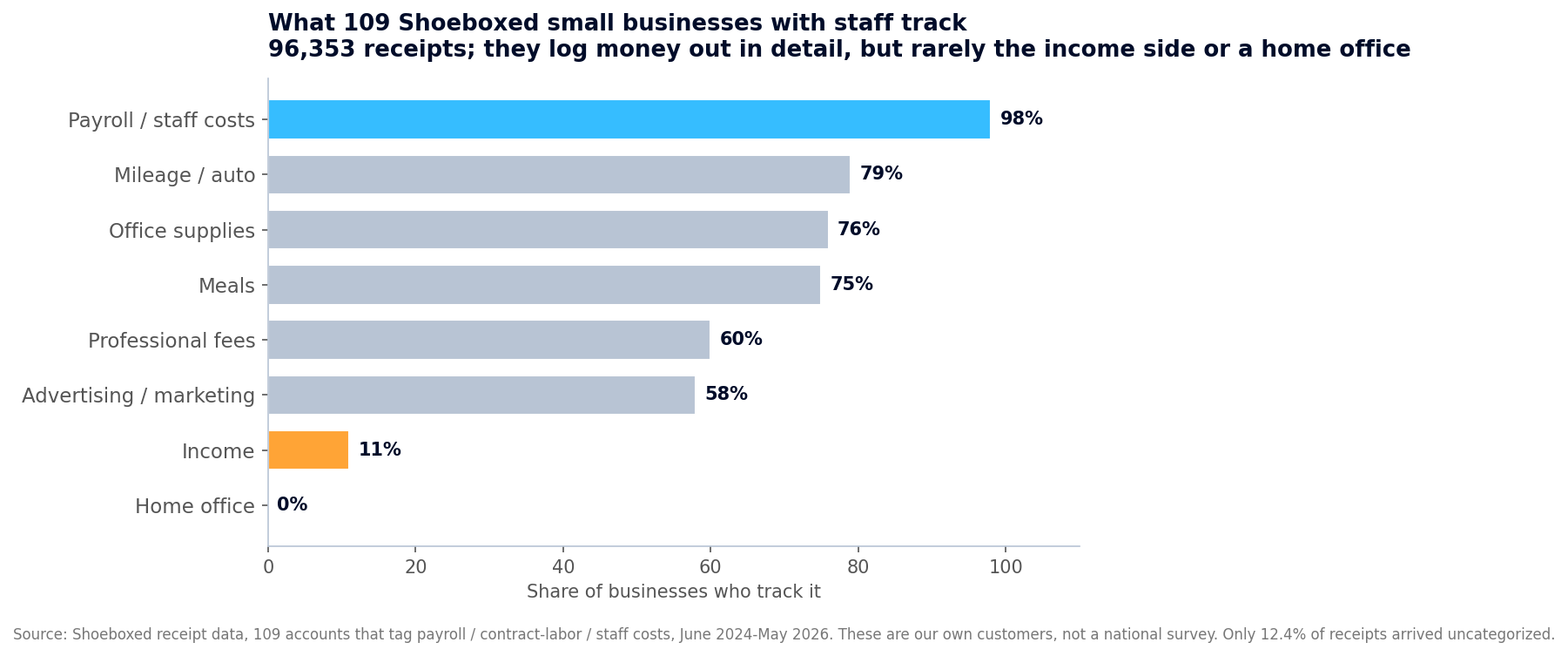 Across 109 Shoeboxed accounts that tag payroll or contract labor and 96,353 receipts, payroll, supplies, meals, and mileage all get tracked. The income side shows up for only 1 in 9 of them, and not one tagged a home office. Both of those are part of the story below.
Look at the bottom two bars, income and the home office. Here's the honest read first. A customer payment never comes in as a receipt, and neither does a home office deduction. So neither one lands in a receipt tool the way a fuel or supply receipt does. That's part of why only 11% of these businesses logged any income, and why none of them logged a home office. A dollar or a deduction that never shows up as a receipt is exactly the kind that slips through at tax time, which is why the spreadsheet gives income and the home office their own spots.
Your books need both sides, or the profit is a guess
A pile of expenses is only half a ledger. If you track every cost and skip what you brought in, the profit number you hand your accountant is half made up. In our data that's the rule, not the exception. These businesses log payroll and supplies and fuel all year, and the income side barely registers.
For a tracker built around write-offs and Schedule C lines specifically, grab the tax expense spreadsheet.
That's the difference between an expense log and a profit and loss. A P&L tells you the one number that matters, what the business kept after costs, and that's the number your taxes are figured on. The Income Statement tab is built for it. You log income on one tab and expenses on another, and the statement pulls both together the way your Schedule C does:
- Total income , everything you brought in.
- Total expenses , every cost, with business meals counted at the 50% the IRS allows, and your mileage and home office flowing in from their own tabs.
- Net profit , what's left after expenses and the home office, and the number you're taxed on.
Log both sides as you go and you always know where you stand, instead of finding out in April. A clean record of money in and money out, backed by your receipts, is also exactly what the IRS wants to see.
The home office deduction most owners skip
When you run a business with staff, you probably picture a home office as something for freelancers. But if you do the books, the payroll, and the vendor calls from a room at home, the IRS lets you deduct the part of your home you use for the business, even if your crew works somewhere else. None of the 109 businesses in our data tagged it, so that's a real deduction sitting untouched.
A lot of owners skip it because they've heard a home office is an audit magnet. That story is stale. The IRS now builds a simplified method right into the form. What keeps you out of trouble isn't skipping the deduction, it's following one real condition:
"Allowed only if that portion is exclusively used on a regular basis for business purposes."
Exclusively means that spot is for work and nothing else. The spare room you turned into an office counts. The kitchen table where the family also eats dinner does not.
Meet that test, keep a simple record of the space (something like "spare bedroom, 11 by 12 feet, desk and business files, no other use"), and the deduction is yours. Then you pick one of two ways to figure it, and the spreadsheet handles both.
The simplified method is the easy one, and it works off a flat rate the IRS sets:
"Standard deduction of $5 per square foot of home used for business (maximum 300 square feet)."
So a 200-square-foot office is a $1,000 deduction, and the 300-square-foot cap works out to $1,500. No receipts, no math past one multiplication.
The actual method usually pays more, especially if you rent or carry a mortgage. You figure what share of your home the office takes up, your office square feet divided by the home's total square feet, so a 150-square-foot office in a 1,500-square-foot home comes to 10%. Then you deduct that share of your rent or mortgage interest, plus utilities, insurance, and repairs, with no $1,500 cap to stop you. You run it on Form 8829, and the IRS describes it like this:
"Use Form 8829 to figure the allowable expenses for business use of your home on Schedule C (Form 1040) and any carryover to next year of amounts not deductible this year."
The Home Office Log tab runs both methods side by side so you can see which one wins. Want it figured for you? Our home office calculator pulls your home's square footage from your address and works out the savings at your bracket. Either way, the deduction lands on line 30 of your Schedule C.
Mileage: the deduction that hides from your receipts
Like the home office, the miles you and your team drive for work never show up on a single receipt, so they slip your mind. Try to remember every supply run, job site, bank trip, and vendor visit you drove last year, and those miles add up fast.
For 2026 the IRS lets you deduct 72.5 cents for every business mile. Log 8,000 business miles in a year and that's $5,800 off your taxable income, for trips you were taking anyway. With this method you skip the gas and repair receipts and track only the miles. The rate changes most years, so check that page for the number for the year you're filing.
The IRS wants one thing here, a record of each trip with the date, where you went, why, and the miles. The Mileage Log tab gives you those four fields and multiplies by the rate for you, and the total lands on line 9 of your Schedule C. If you don't want to keep a log by hand, our mileage log template walks through the easier ways to do it, including letting the Shoeboxed app log the drives for you.
Every business expense, mapped to its Schedule C line
This is the part most expense spreadsheets skip. They list the costs but never tell you where they go on the form. The Expenses tab does both with a dropdown, and so does the table below. You don't have to memorize any of it. The spreadsheet fills in the line for you, and the table is here so you can see where your money lands.
| What you spent money on | Examples | Schedule C line |
|---|---|---|
| Advertising | Ads, your website, signage, business cards | Line 8 |
| Car and truck | Business miles (logged on the Mileage Log tab) | Line 9 |
| Commissions and fees | Sales commissions, referral fees you pay out | Line 10 |
| Contract labor | A 1099 subcontractor, an installer, a freelancer you paid | Line 11 |
| Depreciation and Section 179 | Machinery, computers, big gear (often deductible in full the first year) | Line 13 |
| Employee benefit programs | Health coverage and benefits for your staff | Line 14 |
| Insurance | Liability, property, workers comp | Line 15 |
| Interest | Interest on a business loan or line of credit | Line 16 |
| Legal and professional | Your accountant, a lawyer, a bookkeeper | Line 17 |
| Office expense | Printing, postage, software, small office costs | Line 18 |
| Pension and profit-sharing | Retirement plan contributions for your employees | Line 19 |
| Rent or lease | Your shop, warehouse, or rented equipment | Line 20 |
| Repairs and maintenance | Fixing the gear and the space you work in | Line 21 |
| Supplies | Materials you use up doing the work | Line 22 |
| Taxes and licenses | Business license, permits, payroll taxes | Line 23 |
| Travel | Flights, hotels, out-of-town work trips | Line 24a |
| Meals | Business meals, deductible at 50% | Line 24b |
| Utilities and phone | Power, water, business phone and internet | Line 25 |
| Wages | What you pay W-2 employees | Line 26 |
| Other expenses | Bank and card fees, dues, anything that doesn't fit above | Line 27a |
| Home office | The room you run the business from (logged on the Home Office Log tab) | Line 30 |
| The spreadsheet uses these exact lines, so when you hand your totals to your accountant, every number already knows where it goes. The IRS renumbers a line now and then, so check yours against the Schedule C for your filing year. |
Two of these are worth a gut check. If you use a phone, internet, or a vehicle for both work and your own life, deduct only the business share, not the whole bill. For a vehicle, that share is your business miles divided by all the miles you drive in the year. For a phone or internet line, estimate the slice you use for the business and jot down how you got there, so you can back it up later. The IRS wants a reasonable number, not a stopwatch.
Big-ticket gear is worth a special mention. Machinery, a computer, or other equipment can usually be deducted in full the year you buy it, instead of in pieces over the years. This is the Section 179 write-off, and it covers ordinary business gear well into six figures a year. That's a real cash boost the year you invest, and your accountant can confirm it for your situation.
How you lose the deduction
I've watched good operators hand real money back to the IRS over small bookkeeping slips. Here are the four I see most in our data, and you can avoid all of them.
Receipts with no category. Even in this organized group, about 1 in 8 receipts sat without a category. How you lose the deduction: at audit time, the IRS throws out a charge you can't explain faster than anything else on the return. Tag it the day you get it, not next April.
Never logging your income. This is the big one, because a payment lands as a deposit and never as a receipt, so it rarely gets written down. Most of the businesses in our data track every cost and never record what they brought in. How you lose the deduction: with no income record your profit is a guess, and the IRS doesn't accept guesses. Log each payment the day it clears.
Mixing business and personal in one account. When a vendor payment and a grocery run live in the same account, tax time turns into a treasure hunt. How you lose the deduction: you can't prove a charge was for business, so you skip it instead of guessing, and you overpay. Run a separate business account and card.
Faded receipts. The thermal paper most receipts print on goes blank inside a year. How you lose the deduction: the print fades to gray before your return is even due, and a blank slip proves nothing. Snap a photo the day it prints, and the digital copy outlives the paper.
The easy way: skip the spreadsheet
The spreadsheet is free and it works, and I stand behind it. But I'll be honest about the catch. Someone still has to type every receipt into it and log every payment, and our data shows what happens when that turns into a chore. Receipts go untagged, income never gets recorded, and the books drift.
That's the whole reason Shoeboxed exists, because we do the typing for you. We're a 20-year-old receipt scanning and mileage tracking app. Snap a receipt with the iPhone app or the Android app, forward an email, or mail us a shoebox of paper in our Magic Envelope. Our team in Durham scans the paper and pulls out the date, total, vendor, and category, so every business cost lands in your account already sorted.
The mileage piece is my favorite. The app tracks your drives by GPS, texts you the list at the end of the day, and you reply with which ones were business, so a tax-ready mileage log comes together without anyone keeping it by hand.
Either way, the spreadsheet is yours, no signup and no strings. If you'd like your receipts captured and sorted for you, that's what we do. Shoeboxed Pro runs $29 a month with a 30-day risk-free guarantee. Scan a year of receipts, and if it isn't for you, we refund the money.
Frequently asked questions
What is the best expense spreadsheet for a small business? The one that tracks both sides, income and expenses, ties each expense to its tax-form line, and shows your real profit. Most free spreadsheets track spending only, which leaves you with half a ledger. The free template on this page logs income on one tab and expenses on another, maps every category to its Schedule C line, and builds a profit and loss that subtracts your expenses, your mileage, and your home office to show the net profit you're taxed on.
How do I track business income and expenses in a spreadsheet? Log every payment as it comes in and every cost as you spend it, and keep both in one place so your profit stays current. The free spreadsheet here does the math for you, and the Shoeboxed app can capture the receipts for you if you don't want to type them in.
What business expenses can I deduct? Advertising, payroll and contract labor, commissions, your business phone and internet, software, supplies, business insurance, travel and meals, equipment, the miles you drive for work, and a home office, among others. The table above maps each one to its Schedule C line.
Is this spreadsheet for a one-person business or a freelancer? If you have no employees and file a 1099, use the simpler self-employed income and expense spreadsheet instead. This page is built for a business with vendors and maybe a few people on payroll, so it includes wages, contract labor, and employee benefits.
How long should I keep my records? Three years in the normal case, counted from the date you filed, and longer in a few situations. Keep the digital scan and you can toss the fading paper.
30 Seconds Could Save You Thousands on Taxes
Self-employed? Get an instant, personalized tax-savings estimate.




 4.4 / 5 on