Truck Driver Tax Deductions Worksheet (Free Printable, Google Sheet & Excel)
A free truck driver tax deductions worksheet for owner-operators. Every category mapped to its Schedule C line, plus the per-diem and per-mile rules most worksheets get wrong.


A truck driver tax deductions worksheet should do one job: show you what you can write off, and where each one lands on your tax return. Most of the worksheets online don't do that. They list categories with no rules, half of them are dead PDF links, and not one of them tells a company driver the hard truth.
The hard truth is you can't deduct this stuff anymore.
I'm not a trucker. But I run Shoeboxed, a receipt-scanning company, and we've scanned hundreds of thousands of receipts for owner-operators over the last 20 years.
I pulled the numbers on what truckers keep, built a worksheet around them, and made it free. It covers what an owner-operator can deduct, it maps every category to the right Schedule C line, and it bakes in the two rules truckers miss most: the per-diem meal deduction, and the fact that your rig isn't a "car."
Get the worksheet
Copy the worksheet to my Google Drive →
Tap it, sign in to Google, and choose Make a copy. The sheet is yours to type in, and nothing you enter touches my version.
Want another format? Download it as Excel (xlsx), or print the PDF and fill it in by hand in the cab.
The worksheet has four tabs:
- Deductions Worksheet. Every category an owner-operator can deduct, with a column for your yearly total and the Schedule C line it belongs on.
- Per-diem helper. Type in your nights away from home and it does the meal math for you.
- Home Office Log and Mileage Log. The two deductions that don't work like a normal receipt.
- A 25% off code for Shoeboxed, in case you'd like us to do the typing instead.
If you only do one thing on this page, copy the worksheet. The rest of this article explains the rules behind it, because a couple of them put real money back in your pocket.
First, are you an owner-operator or a company driver?
This is the question that decides everything, so settle it first.
If you're an owner-operator , meaning you run your own truck under your own authority or you're leased on to a carrier and paid on a 1099, you're a business. You file a Schedule C, and you deduct every business cost below.
If you're a company driver who gets a W-2, the rules changed on you. Employees used to write off unreimbursed job costs as a miscellaneous itemized deduction, and the IRS took that away. Publication 529 says so in plain language:
You can no longer claim any miscellaneous itemized deductions, unless you fall into one of the qualified categories of employment.
Truck drivers don't fall into one of those categories. So if you drive on a W-2, this worksheet won't help your tax return. Ask your carrier about its per-diem or reimbursement program instead.
| How you're paid | You file | Deduct your truck costs? |
|---|---|---|
| Owner-operator (own authority or leased-on, 1099) | Schedule C | Yes |
| Company driver (W-2) | Form 1040, no Schedule C | No |
| The fork that decides whether this worksheet is yours: owner-operators deduct everything below; W-2 company drivers can't write off unreimbursed job costs. |
The rest of this article is for owner-operators.
What an owner-operator can deduct
Truckers already know the big one in their gut: fuel. When we looked at 166 owner-operator accounts in our data, real drivers fueling at the big truck stops, fuel and auto was the single biggest category by far, almost 4 in 10 of every receipt they scanned. Across 570,402 receipts, nothing else came close.
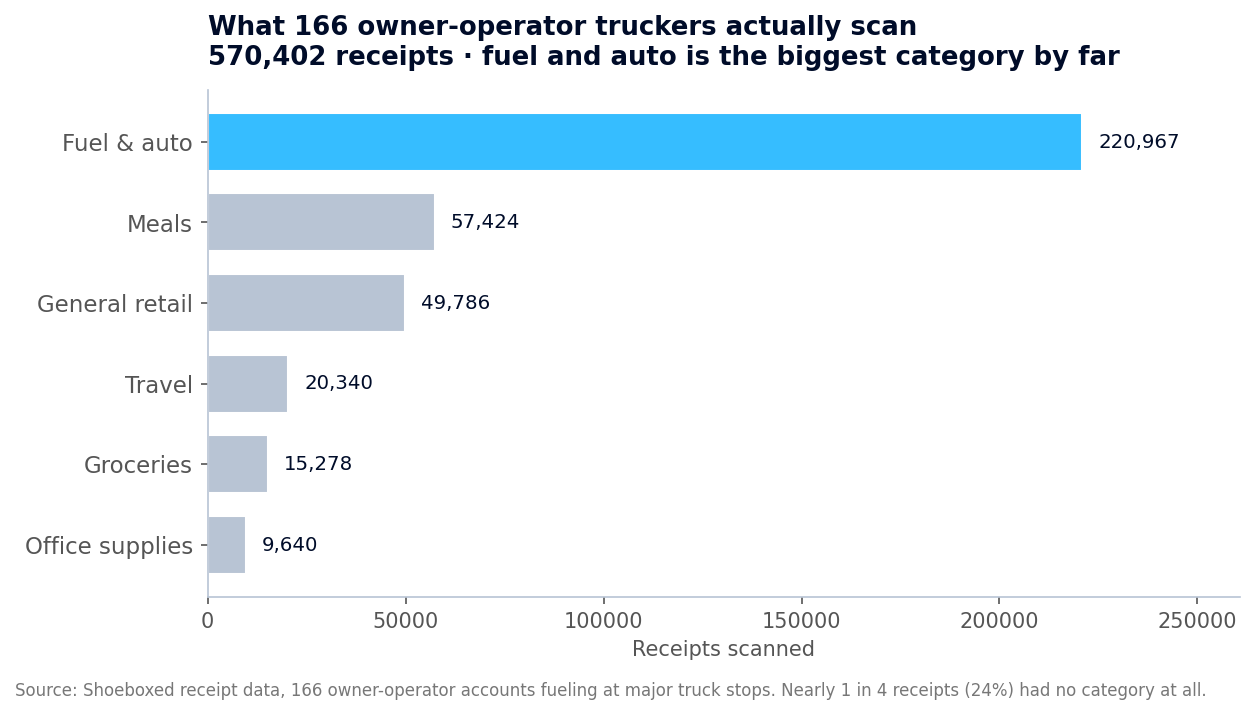 Across 166 owner-operator accounts and 570,402 receipts, fuel and auto is the biggest category by far, almost 4 in 10 receipts. About 1 in 4 had no category at all.
Truckers stay on top of fuel. The money they leave behind sits in the other half of the worksheet, the categories that don't print on a pump receipt. Here's the full list, with the line each one rides on.
| What you spent money on | Schedule C line |
|---|---|
| Fuel and diesel | Car & truck (line 9) |
| Repairs, maintenance, tires | Car & truck (line 9) |
| Tolls, scales, parking | Car & truck (line 9) |
| Truck insurance (liability, cargo, bobtail) | Insurance (line 15) |
| Truck lease payments | Rent or lease (line 20) |
| Truck depreciation and Section 179 | Depreciation (line 13) |
| Interest on your truck loan | Interest (line 16) |
| Permits and licenses (IFTA, Form 2290, CDL, plates) | Taxes & licenses (line 23) |
| ELD, load board, dispatch, accounting software | Office expense (line 18) |
| Work gear (gloves, boots, straps, chains, tarps) | Supplies (line 22) |
| Phone and internet (business share) | Utilities & phone (line 25) |
| DOT physical, dues, legal and professional fees | Legal & professional (line 17) |
| Meals on the road (per-diem method) | Meals (line 24b) |
| Home office | Line 30 |
| The worksheet uses these exact Schedule C lines, so when you hand your totals to your accountant, every number already knows where it goes. |
Two of those lines cover the truck itself, and you use one or the other, not both. If you lease, your payments go on the lease line. If you own or finance the truck, you write it off through depreciation and Section 179, which are just the ways you deduct the cost over time, or a big chunk of it the year you buy. Not sure which fits you? That's a good question for your accountant.
A few of these get their own tab in the worksheet, because they don't work like a normal receipt. Those are the next two sections, and they're the ones worth slowing down for.
One more to log while you're here: the Heavy Highway Vehicle Use Tax. If your truck has a taxable gross weight of 55,000 pounds or more, you owe it on Form 2290, and it's a deductible business cost that goes on the permits and licenses line.
The per-diem deduction most truckers do the hard way
This is the most-missed money in trucking.
When you're on the road overnight, you can deduct your meals. Most drivers do it the slow way: save every gas-station sandwich and diner receipt, total them up, and deduct half. That's a year of greasy paper for a middling number.
The IRS built a better way for you. If you're subject to the Department of Transportation's hours-of-service rules, you can skip the receipts and claim a flat daily meal allowance. Publication 463 sets it at $80 a day for 2025. And here's the part that makes it big: most people deduct only half their meals, but DOT drivers get more.
If you are subject to the Department of Transportation's "hours of service" limits, you can deduct 80% of your business-related meal expenses.
You claim the full $80 for each day on the road, and 75% of it for the day you leave and the day you get back, since the IRS prorates those partial days. Then you deduct 80% of the total. Here's how that lands per day:
| Day on the road | Meal allowance | You deduct (80%) |
|---|---|---|
| A full day out | $80 | $64 |
| Day you leave or return (75%) | $60 | $48 |
| Spend 250 days a year on the road and that adds up to roughly $16,000 in meal deductions, with no receipts to keep. The per-diem helper tab does the math for you. |
Here's the part most drivers miss: you claim that $80 whether you spent it or not. Spend less than $80 a day on food, the way most drivers do, and the per-diem beats totaling up receipts, with none to keep. In our data, meals were only about 1 in 10 of every receipt these owner-operators scanned, so plenty of them are still doing it the hard way.
One note on the number: the $80 rate is for the 2025 tax year. The IRS resets it every October 1, so check the current figure before you file.
How you lose the deduction: you need a record of the nights you were away from home, not the meal receipts themselves. A logbook, an ELD record, or your settlement statements all work. The per-diem helper tab gives you a place to keep the count.
Your truck isn't a "car," so deduct actual costs
It's tempting to track your miles and multiply by the IRS cents-per-mile rate, the way you would for a car. For your rig, that's wrong, and it can cost you thousands.
The standard mileage rate is for cars. Publication 463 is specific about what doesn't count as a "car":
A vehicle used directly in the business of transporting persons or property for compensation or hire.
That's your truck. So the cents-per-mile shortcut is off the table for it. You deduct your actual costs instead: fuel, repairs, tires, insurance, depreciation, the works. For a working truck, the actual costs blow past anything a per-mile rate would give you, so this is good news. The worksheet builds in the actual method, which is why fuel, repairs, and tires each get their own line.
How you lose the deduction: mixing up the two vehicles. The standard mileage rate still works for a personal car or pickup you drive on business errands, a parts run, a trip to the CPA, a bank deposit. That's what the Mileage Log tab covers, while your truck stays on the actual-cost lines. Keep the two separate and you collect on both.
Your Schedule C business code
Filing your Schedule C, you'll need a principal business code. People get stuck on this small thing. For trucking, the IRS code list gives you three to choose from:
- 484120 for general freight, long distance (most owner-operators)
- 484110 for general freight, local
- 484200 for specialized freight, including household moving
Pick the one that fits your hauls and move on.
The recordkeeping mistakes that cost truckers
These are the traps I see in the data and hear about from drivers. You can avoid all of them once you know they're there.
Receipts with no category. About 1 in 4 receipts in our owner-operator data had no category at all. How you lose the deduction: at audit time, a receipt you can't explain is the easiest thing for the IRS to throw out. Tag it the day you get it, not in April.
Mixing the business and the personal. When your truck fuel and your family groceries run through the same card, you can't tell what's deductible. How you lose the deduction: a business cost buried in a personal account with no clear record is the first thing an auditor disallows. Run a separate business checking account and card.
No record of nights away. That same per-diem trap shows up here, and it bites even the drivers who track everything else. How you lose the deduction: without a count of the nights you spent on the road, you can't back up the meal deduction, and it's a big one. Keep the log.
Faded fuel receipts. Thermal paper goes blank inside a year. How you lose the deduction: the print on a pump receipt fades to gray before your return is even due. Snap a photo the day it prints, and the digital copy outlives the paper.
The easy way is to skip the shoebox
I built this worksheet and I stand behind it. But I'll be honest: the typing is the part nobody enjoys, and our data shows what happens when it becomes a chore. Receipts go untagged, the per-diem log never gets kept, and the books drift.
That's the whole reason Shoeboxed exists, because we do the typing for you. We're a 20-year-old receipt scanning and mileage tracking app. Snap a fuel receipt at the pump, forward an email, or mail us a shoebox of paper in our Magic Envelope. Our team in Durham scans the paper ones and pulls out the date, total, vendor, and category. Your fuel, repairs, and tolls land in your account, sorted and ready to drop into a worksheet like this one.
The mileage piece is my favorite for the personal-vehicle side. The app tracks your drives by GPS, texts you the list at the end of the day, and you reply with which ones were business. A tax-ready mileage log builds itself. The full writeup lives in our mileage log template article.
Either way, the worksheet is yours, free and no strings. If you'd like your receipts captured and sorted for you, that's what we do. Shoeboxed Pro runs $29 a month with a 30-day risk-free guarantee. Scan a year of fuel receipts, and if it isn't for you, we refund the money.
Start a Shoeboxed account → or grab the iPhone app or the Android app.
To track your costs all year instead of totaling them once, our owner-operator expense spreadsheet is the ledger version of this worksheet. And if you run a home office for the business, the free home office calculator figures that deduction from your address in about 30 seconds.
Frequently asked questions
What can a truck driver deduct? An owner-operator deducts fuel, repairs, tires, insurance, the truck itself, permits, software, work gear, the business share of a phone, meals by per-diem, and a home office. The worksheet lists all of them with their Schedule C lines.
Can a company (W-2) driver deduct truck expenses? Not anymore. The IRS suspended the unreimbursed employee expense deduction, so W-2 drivers can't write off out-of-pocket job costs. Run them through your carrier's reimbursement or per-diem program instead.
How does the trucker per-diem work? If you're subject to DOT hours-of-service rules, you deduct a flat $80 per day for meals (the 2025 rate) instead of saving receipts, and you deduct 80% of it instead of the usual 50%. You need a record of the nights you spent away from home.
Can I use the cents-per-mile rate for my truck? No. Your rig isn't a "car" for the standard mileage rate, so you deduct actual costs like fuel, repairs, and depreciation. The mileage rate covers only a personal car or pickup you drive on business errands.
How long should I keep my records? Three years in the normal case, counted from the date you filed. Hang on to anything tied to the truck itself longer, since you'll need it to back up depreciation. Keep the scan and you can toss the fading paper.
If you elect S-corp status on your owner-operator business, the Augusta Rule is one of the bigger strategies that opens up.
Get a per diem on the road? Here's whether your per diem is taxable, including the special DOT meal allowance for drivers.
30 Seconds Could Save You Thousands on Taxes
Self-employed? Get an instant, personalized tax-savings estimate.




 4.4 / 5 on