Free Realtor Expense Spreadsheet + Tax-Deduction Worksheet (Schedule C)
A free real estate expense spreadsheet for agents who file Schedule C. Copy it, track your commissions and write-offs, and see every deduction land on the right tax-form line.


I used to run HomeFinder.com (think Zillow or Realtor.com) back when a bunch of big newspaper companies owned it. Real estate agents made up our main customer base. I spent years selling to them, listening to them, and watching how they work. Then I went and got my own real estate license, because I wanted to understand the job from the inside.
Here's what I learned: it's a hard business. You're not an employee. Nobody hands you a salary or takes the taxes out for you. You're a commission-only business of one, and you front the cost of every listing, every drive, and every closing gift yourself, often months before a deal pays.
I admire agents for that. And the least I can do is make one part easier. So I built a free real estate expense spreadsheet for agents who file a Schedule C. You copy it, log your commissions and your spending, and it shows you what you made and every deduction you can take.
One quick note before you grab it: it's built for working agents paid on commission. If you own rental property and collect rent, that income goes on a Schedule E, not a Schedule C, so this sheet isn't built for you.
Get the realtor expense spreadsheet
Copy the spreadsheet to my Google Drive →
Tap it, sign in to Google, and choose Make a copy. The sheet is now yours to type in, and nothing you enter touches my version.
Want it in Excel instead? Download it as an Excel file (xlsx).
Illustrative photo, not an actual Shoeboxed customer. The paperwork side of the job is where deductions get won or lost.
The sheet has two main tabs and three bonus tabs:
- Tax-Deduction Summary. Your profit and loss. It fills in by itself, shows your net profit, and doubles as your deduction worksheet.
- Transactions. Where you do the work, with one row every time a commission comes in or you spend on the business.
- Bonus tabs. A mileage log, a home office log, and a 25% off code for Shoeboxed.
Here's the part I'm proudest of: every category is labeled with the Schedule C line it belongs on. The mileage log feeds line 9, and the home office log feeds line 30. So when you hand the totals to your accountant, every number already knows where it goes.
I left the balance sheet out on purpose. You don't need one to run a real estate business. You need to know what you made and what you can write off, and that's what this sheet does.
If you only do one thing on this page, copy the sheet. The rest of this article explains how it works and why it saves you money.
You're a business owner, not an employee
Most agents hang their license at a brokerage with a big name on the sign, so it can feel like you work there. You don't, at least not the way the tax code sees it.
A licensed agent paid on commission is self-employed, not an employee of the brokerage. The IRS even has a name for it, a statutory nonemployee, and Section 3508 of the tax code spells it out:
"In the case of services performed as a qualified real estate agent ... the individual performing such services shall not be treated as an employee, and the person for whom such services are performed shall not be treated as an employer."
What that means for you is simple. Your commissions and your business spending go on a Schedule C, the same form a plumber or a freelance designer uses. That's the good news at tax time, because an employee can't write off their mileage or their phone, and you can.
It also means nobody is tracking any of this for you. There's no payroll department and no W-2 with the numbers already filled in. If you don't write it down, it didn't happen as far as the IRS is concerned, and that's the whole reason this spreadsheet exists.
Your Schedule C is just a profit and loss statement
The tax form scares people for no reason. A Schedule C is a profit and loss statement, nothing more.
Your commissions go in at the top. Your business spending comes out of the bottom, and what's left is your net profit, which lands on line 31. The IRS instructions say it plainly: "Subtract line 30 from line 29. The result is your net profit."
The Tax-Deduction Summary tab runs that exact math for you. Here's a clean month for a working agent:
| Line | Item | Amount |
|---|---|---|
| Part I | Commissions and income | $11,250 |
| Line 28 | Business deductions | $2,564 |
| Line 29 | Tentative profit | $8,686 |
| Line 30 | Home office | $750 |
| Line 31 | Net profit (what you're taxed on) | $7,936 |
That last number is the one that matters. You don't pay tax on your commissions, you pay tax on your profit, and every honest deduction you log shrinks it.
The half-a-ledger problem
I want to show you something we found in our own data, because it explains why most expense spreadsheets quietly fail an agent.
We pulled the records of 68 real estate accounts on Shoeboxed, 44,164 receipts in all. Only 26.5% of those agents had ever logged a single dollar of income. Almost three out of four tracked what they spent and never wrote down what they made.
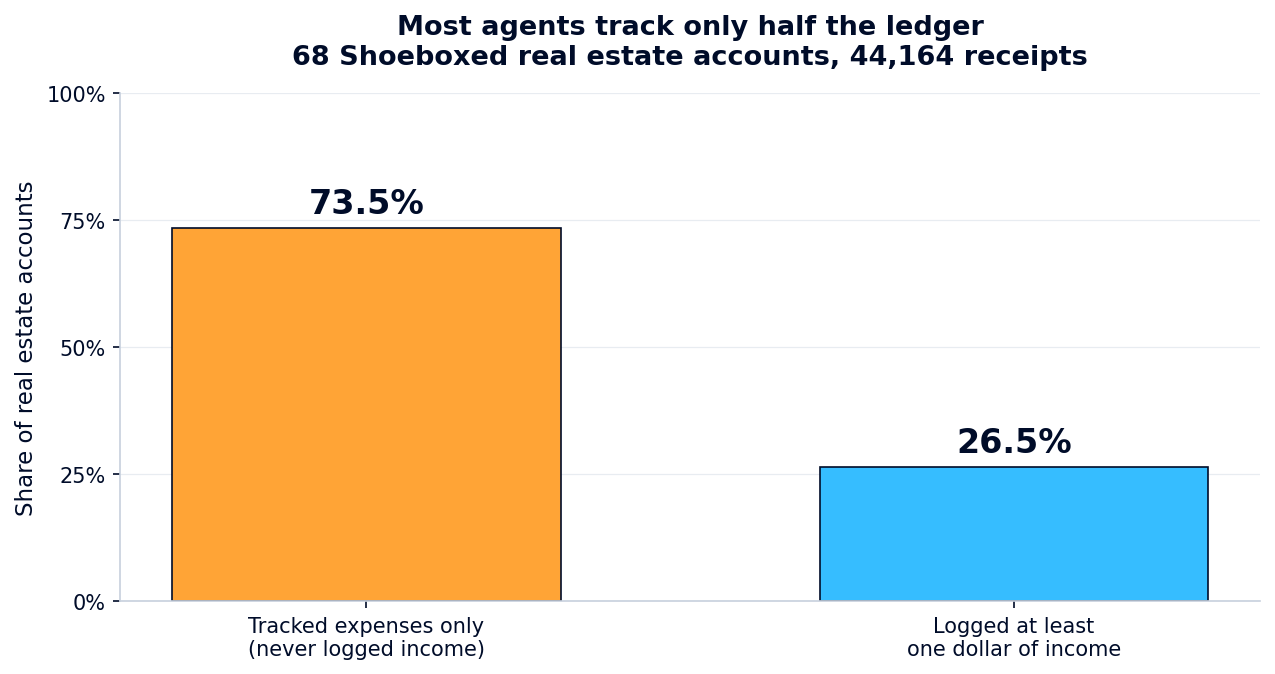 Across 68 Shoeboxed real estate accounts, 73.5% tracked expenses but never logged a dollar of income.
It's not because agents are careless. It's because your commission doesn't show up as a receipt. It shows up as a statement from the closing or a deposit from your brokerage, so it never lands in the same pile as the expenses you do save.
But a pile of expenses is only half a ledger. If you track what you spent and never record what you earned, the profit number you hand your accountant is a guess. That's why the spreadsheet has an income side built right in. You log the commission the day it closes, and the summary subtracts your expenses to show your real profit.
Every realtor deduction, mapped to its Schedule C line
This is the part the "tax deductions worksheet" you've been searching for usually skips. It lists the write-offs but never tells you where they go on the form. The summary tab does both, and so does the table below.
One number from our 68 agents is worth calling out: around 50 of them, roughly three out of four, logged car and fuel receipts. That fits the job, because you drive all day, so the miles are real money. Mileage gets its own section next.
| What you spent on | Examples | Schedule C line |
|---|---|---|
| Marketing and advertising | Listing photos, drone video, signage, staging, mailers, your website | Line 8 |
| Car and truck | Miles driven to showings, open houses, and closings | Line 9 |
| Commissions and fees paid | Referral fees, brokerage desk and franchise fees | Line 10 |
| Contract labor | Transaction coordinator, photographer, virtual assistant | Line 11 |
| Insurance | Errors and omissions, general liability | Line 15 |
| Office expense | Client database (CRM), your MLS listing software, printing, postage | Line 18 |
| Supplies | Lockboxes, signs, open-house supplies | Line 22 |
| Dues and licenses | MLS dues, board and association dues, license renewal | Line 23 |
| Meals | Client and business meals, deductible at 50% | Line 24b |
| Phone and utilities | Business phone line, internet, office electric | Line 25 |
| Continuing education | CE courses, designations, coaching | Line 27a |
| Client and closing gifts | Capped at $25 per client per year | Line 27a |
Two of these need a quick gut check. If you use your phone or your car for both work and your own life, deduct only the business share, not the whole bill.
Pick the category in the spreadsheet's dropdown and it carries that line number with it. At tax time the summary already has every dollar sorted onto the form.
Mileage and the home office: an agent's two biggest write-offs
These two deserve their own section, because they're the largest deductions most agents take and the two they most often get wrong.
Mileage. Think about every showing, open house, listing appointment, and closing you drove to last year. That's a lot of miles, and for 2026 the IRS lets you deduct 72.5 cents for each one. Here's how the IRS set the rate:
"Beginning Jan. 1, 2026, the standard mileage rates for the use of a car, van, pickup or panel truck will be: 72.5 cents per mile driven for business use, up 2.5 cents from 2025."
Drive 12,000 business miles in a year and that's $8,700 off your taxable income. You don't have to rebuild it from memory. Log each trip on the Mileage Log tab as you go, with the date, where you went, and the miles, and the tab multiplies by the rate and sends the total to line 9. For the current rate in any year, our IRS mileage rate page stays up to date.
The home office. Do you skip this one because you're never home? Most agents do, and they leave money behind, because the test isn't where you meet clients. IRS Publication 587 says your home office qualifies as your principal place of business if you use it regularly and only for the back-office side of the work, like your contracts, your scheduling, and your bookkeeping, and you have no other office for that.
You sell houses out in the field, but you write the offers and chase the paperwork from a spare room at home. That spare room counts.
You can use the simplified method, but that only pays $5 per square foot up to 300 square feet, so $1,500 a year at most. For most agents with a mortgage or rent and real utility bills, the actual method beats that cap, sometimes by a lot, though it isn't bigger for everyone. To see which one wins for your own address, try our home office calculator. The home office log tab handles either method and feeds line 30.
The mistakes that cost agents money at tax time
I've watched good agents hand real money back to the IRS over small bookkeeping slips. Here are the four that bite the most.
Mixing personal and business in one account. When the commission deposit and the grocery run live in the same checking account, tax time turns into a treasure hunt through a year of mixed-up charges. Open a separate business account and run everything through it.
How you lose the deduction: you can't prove a charge was for business, so you skip it instead of guessing, and you overpay.
Going over the gift cap. You can write off a closing gift, but the IRS caps it. Section 274(b) limits the gift deduction to $25 per client per year. The $80 bottle of wine still costs you $80, but only $25 of it is deductible.
How you lose the deduction: you write off the full $80, and in an audit the IRS knocks it down to $25 and starts questioning the rest of your return.
Skipping a 1099 for the people you pay. If you paid a referral fee, a transaction coordinator, or a photographer, you may owe them a Form 1099-NEC. The threshold is $600 for pay during 2025, but a 2025 law (amending the tax code) raised it to $2,000 for pay made after December 31, 2025.
How you lose the deduction: you never filed the 1099, and the IRS disallows the expense you were trying to write off.
Waiting until April. This is the big one, and our data shows it plainly. Almost three out of four agents in our records never logged their income all year, which means they rebuild the whole picture from memory in the spring. Log it as it happens and there's nothing to rebuild.
How long to keep your records
Keep your records for at least three years after you file. The IRS can look back that far on a normal return.
Hold them six years if you ever leave off more than a quarter of your income, and keep them for good if you never filed at all. The IRS lays out the full recordkeeping rules on its site.
The tiers are a headache. We tell our own customers to keep everything for seven years and stop doing the math, which is easy when the records live in an app instead of a drawer.
This is exactly why a digital pile beats a shoebox. A photo of a receipt doesn't fade, doesn't get lost in a move, and is still there in year six when you need it.
The easy way: skip the spreadsheet
The spreadsheet is free and it works, and I'm proud of it. But I'll be honest with you about the catch. Someone still has to type every receipt into it and chase every closing statement, and most agents I know are out at a showing, not sitting at a desk doing data entry.
That's the exact gap we built Shoeboxed to close. Snap a photo of a receipt, forward an email, or mail us the shoebox in our Magic Envelope. We scan it, tag it by Schedule C category, and keep it for as long as the IRS could ask. The app even tracks your drives to showings in the background, so your mileage log fills itself.
You came here for a spreadsheet, and it's yours, free, no signup. If the typing isn't your idea of a good Tuesday, here's how Shoeboxed helps real estate agents do it the lazy way.
30 Seconds Could Save You Thousands on Taxes
Self-employed? Get an instant, personalized tax-savings estimate.




 4.4 / 5 on