IRS Receipt Requirements: What to Keep, What to Toss, and the $75 Rule
What the IRS actually requires for business receipts, the $75 rule that lets you skip the paper, and how long to keep everything else.


If a business expense is under $75, the IRS does not need the paper receipt. You need a record that the expense happened, but the slip itself can go in the recycling.
For most of the paper piling up on your desk, that is the whole answer. There is one exception that catches people (lodging, which always needs a receipt), and "a record" means something specific, so stick with me for a minute. I will show you the actual IRS rule, word for word, so you do not have to take my word for any of it.
I'm Doug, and I run Shoeboxed, where we have scanned and sorted millions of receipts for small business owners since 2007. When I pulled our own numbers for this article, one of them stopped me: 57% of the receipts our customers send us are under $75. So more than half of the paper you are saving out of fear, the IRS already says you can let go of, and most people have no idea.
The $75 rule, in one plain sentence
The IRS does not require a receipt for a business expense under $75, with one exception (lodging, which I will get to). Here is the rule straight from IRS Publication 463, Chapter 5:
Documentary evidence isn't needed if any of the following conditions apply. … Your expense, other than lodging, is less than $75. You have a transportation expense for which a receipt isn't readily available.
"Documentary evidence" is the IRS term for the paper trail: the receipt, the bill, the canceled check. So when they say it "isn't needed" under $75, they mean exactly that. No slip required.
The rule underneath that plain-English summary is a Treasury Regulation, and it spells out the same thing in legal language:
documentary evidence … is required for … (1) Any expenditure for lodging while traveling away from home, and (2) Any other expenditure of $75 or more.
Read that backwards and you get the friendly version: lodging always needs a receipt, anything $75 or more needs a receipt, and everything below that line does not. The rule also says nothing about how you pay. Whether you used cash, a card, or a check, the $75 line is the same.
How much of your shoebox this actually covers
I do not love claims without numbers behind them, so here are ours. Across 2.67 million receipts from 8,728 businesses since January 2024, this is where the dollar amounts land:
| Receipt size | Share of all receipts |
|---|---|
| Under $25 | 27% |
| $25 to $75 | 30% |
| Under $75 (skip the paper) | 57% |
| $75 and up (keep the receipt) | 43% |
So when you stand at the kitchen table sorting that shoebox, a little more than half of it is paper you are free to let go of. It gets better when you look at what those small receipts are. Here is the under-$75 pile broken down by category:
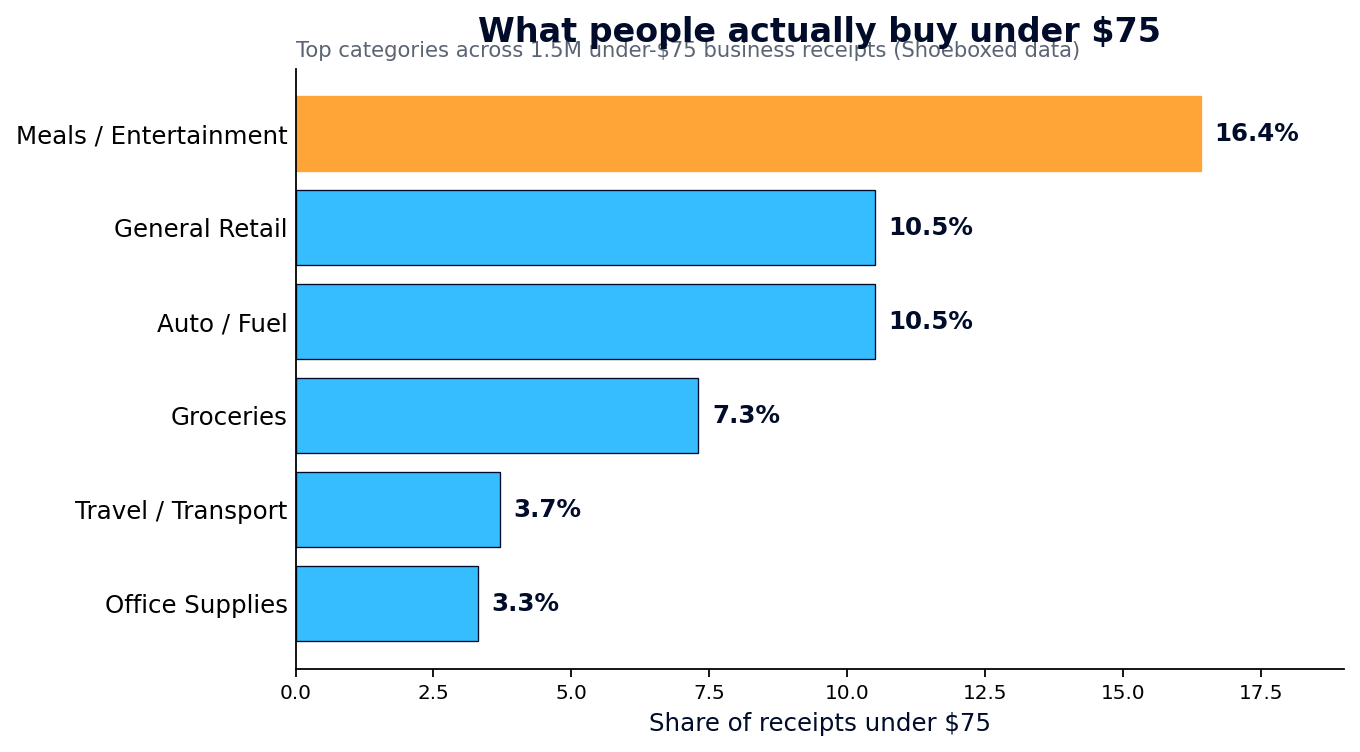
The single biggest category under $75 is meals, at about 16% of the pile. After that comes everyday retail, then gas and auto. The receipts people sweat over most are the small ones: the coffee with a client, the tank of gas, the quick supply run. Those are the receipts the IRS frees you from saving paper for. (Meals come with their own small wrinkle, which I cover in the restaurant receipt rules if you eat out for work a lot.)
One more number worth sitting with: even with all that freedom, 23% of those under-$75 receipts reached us with no category at all. The paper is optional, but a record of what the expense was for is not. That missing record is the one thing that trips people up in an audit, and it is what the rest of this article is about.
What the IRS actually requires for a business expense
Here is the part that trips people up. "No receipt required" does not mean "no record required." The IRS still wants you to be able to prove four simple things about every business expense:
- The amount you spent
- The date you spent it
- The place you spent it
- The business reason for the expense
Straight from Publication 463:
Documentary evidence will ordinarily be considered adequate if it shows the amount, date, place, and essential character of the expense.
For an expense of $75 or more, the receipt is how you prove those four things, so you keep it. For an expense under $75, you still need those four facts written down somewhere, but a short note in a log is enough. You do not need the slip to back it up.
The one $75 exception that trips people up: lodging
Lodging is the exception, and it is the one that costs people money. You need a receipt for a hotel or motel no matter how cheap it was. A $40 roadside motel still requires the paper slip.
The rule calls it out by name twice. The plain-English version says the under-$75 break applies to your expense "other than lodging." The regulation lists lodging first, before it ever mentions the $75 figure. So if you travel for work, sort your hotel receipts into their own pile and never throw one away, because that is the one place the $75 rule will not save you.
Does the IRS require receipts under $75?
No, for everything except lodging, but you do need a record. Think of it as trading one piece of paper for one line in a logbook. Instead of a gas receipt, you write down: March 4, $48, Shell on Route 9, drove to the job site in Madison. That line does the same job the receipt would have, and the IRS accepts it.
A paper notebook, a spreadsheet, or an app like Shoeboxed all work. What matters is that the note exists and that you wrote it down around the time it happened, not three years later when an auditor calls.
Do bank statements count as receipts for taxes?
Not on their own, and this is the most common mistake I see. A bank or credit card statement proves you paid someone, but it does not prove what you bought or that the purchase was for your business. The IRS is blunt about this in Publication 463:
A canceled check, together with a bill from the payee, ordinarily establishes the cost. However, a canceled check by itself doesn't prove a business expense without other evidence to show that it was for a business purpose.
A line on your statement that reads "Office Depot, $112" could be a business printer or a kid's school supplies, and the statement cannot tell the difference. So the IRS will not accept it alone for an expense that needs a receipt. Pair the statement with the receipt, or for an under-$75 expense, pair it with a note explaining the business purpose. The statement is good support, but it is not the whole story.
Are scanned receipts acceptable to the IRS?
Yes. A clear photo or scan is just as good as the paper original, and you are allowed to throw the paper away once you have a legible digital copy. The IRS says so in Publication 583:
All requirements that apply to hard copy books and records also apply to electronic storage systems … The electronic storage system must index, store, preserve, retrieve, and reproduce the electronically stored books and records in legible format. All electronic storage systems must provide a complete and accurate record of your data that is accessible to the IRS.
Two words there are worth underlining: legible and accessible. A blurry photo buried in a camera roll of 9,000 pictures counts as a scan, but it fails both tests. A receipt scanned, read, and filed where you can pull it up in ten seconds passes. That gap between "I took a picture" and "I can find it in an audit" is the problem Shoeboxed solves.
For keeping those records readable for the whole window, our receipt storage guide covers the storage side.
How long do you keep receipts for taxes?
The general rule is three years from the date you filed the return, which covers the normal window the IRS has to audit you. A few situations stretch it:
- Six years if you left out more than 25% of your income, which means serious underreporting, not an honest small mistake
- Seven years if you are writing off a bad debt or worthless security
- Forever if you never filed a return, or filed a fraudulent one
For most small business owners, "keep it three years, seven to be safe" is the simple answer. The nice thing about scanning is that storing seven years of receipts costs you nothing but disk space, instead of a closet full of shoeboxes.
The record that replaces the receipt
When you skip the paper on a sub-$75 expense, here is the note that takes its place. Capture these five things and you are covered:
- Date of the expense
- Amount you spent
- Where you spent it (the vendor)
- Business purpose (the why, in a few words)
- Who was there , for a meal or entertainment expense
For driving, the "receipt" is your mileage log, not a gas slip. The IRS wants the date, the miles, and the business reason for each trip, then you multiply by the standard rate. (Here is the current IRS mileage rate and how to claim it.) And if you lost a receipt for something over $75, do not panic, because there is a way to rebuild the record, which I cover in what the IRS accepts when you lose a receipt.
The hard part of the $75 rule is the log, not the receipt
Here is the honest catch. The $75 rule frees you from the paper, but it does not free you from the record. You still need a log that shows the amount, the date, the place, and the business purpose, and for most people that log is the part that never gets done. The receipt was easy to toss, and the note that should have replaced it never got written.
This is the exact problem Shoeboxed solves, so take the pitch with that in mind. The whole point is to make both halves easy: getting the expense in, and building the log out of it.
Getting a receipt in takes seconds, whichever way you like to work. On your phone, you snap a photo in the app. At your desk, you can email receipts straight to your account, upload a batch of photos, drag and drop PDFs, or set up the Gmail plugin so emailed receipts file themselves. Or mail us a stuffed Magic Envelope and let us do the typing for you.
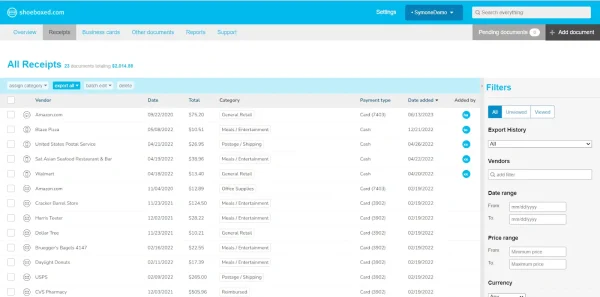
From there, the log builds itself. Every receipt becomes a line with the vendor, date, amount, and category already filled in, and you add the business purpose right on it, which is the one thing the $75 rule still asks of you.
At tax time, or every month if your bookkeeper likes it that way, you export a clean expense report with the images attached, the kind the IRS accepts. Better yet, add your accountant or bookkeeper as a user and let them pull what they need themselves. Prefer to start from a blank one and keep it by hand? Here is our free business expense tracker template.
No shoebox stuffed full of receipts, no guessing what a charge was for, and no scramble in April to rebuild a log from memory. That is the whole idea: keep the record the IRS wants, and skip the paper it doesn't.
Shoeboxed pricing starts at $9 a month, and you can start without paying anything. The mobile app comes with a 7-day free trial and no payment required up front, so the easiest way in is to download it and scan a few receipts. Sign up on the web instead and you get a 30-day risk-free, money-back guarantee.
Start a Shoeboxed account → or grab the mobile app for a free 7-day trial and get your mileage receipts created magically for you:


Frequently asked questions
Do I need receipts for expenses under $75?
No, with one exception. The IRS does not require a receipt for a non-lodging business expense under $75, as long as you keep a record showing the amount, date, place, and business purpose. Lodging always requires a receipt, regardless of amount.
Does the $75 rule apply to all business expenses?
Almost. It applies to most small expenses like meals, gas, parking, and supplies. It does not apply to lodging, which needs a receipt at any dollar amount, and it never removes the need to record the business purpose of the expense.
Do credit card statements count as receipts?
Not by themselves. A statement proves you paid, but not what you bought or why it was for business. For an expense that needs a receipt, keep the itemized receipt. For an under-$75 expense, the statement plus a short note on the business purpose is enough.
What about receipts for employee reimbursements and expense reports?
The same $75 line applies under an accountable plan. Your employees do not need receipts for non-lodging expenses under $75, but they do need to log the amount, date, place, and business purpose, and lodging still needs a receipt. Many companies set their own lower threshold, often requiring a receipt for everything over $25, because it makes bookkeeping cleaner. The IRS sets the floor at $75, and your own policy can be stricter.
What if I lost a receipt for something over $75?
You can still claim the expense if you reconstruct a reasonable record from other evidence: a bank statement, a calendar entry, or an email confirmation, plus a note on the business purpose. Here is the full walkthrough on lost receipts.
The $75 rule does double duty on business travel. See is per diem taxable for how the same cutoff decides whether a travel per diem stays tax-free.
About the author. I'm Doug. I bought Shoeboxed in late 2025 with an SBA loan after fifteen years of running other people's companies as CEO. I'd used Shoeboxed myself back in 2010 at a previous gig and called it magical even then. I use it daily now. Small business owners deserve every dollar they're legally entitled to keep, which is why I bought Shoeboxed and work hard to make it better.
Sources
- IRS Publication 463, Travel, Gift, and Car Expenses , Chapter 5: irs.gov/publications/p463
- 26 CFR § 1.274-5, Substantiation requirements : law.cornell.edu/cfr/text/26/1.274-5
- IRS Publication 583, Starting a Business and Keeping Records : irs.gov/publications/p583
- IRS, 2026 standard mileage rates : irs.gov/newsroom
- Shoeboxed receipt data: 2,668,870 USD receipts across 8,728 business accounts, January 2024 to May 2026, aggregated.
30 Seconds Could Save You Thousands on Taxes
Self-employed? Get an instant, personalized tax-savings estimate.




 4.4 / 5 on